Artist. Writer. Curator. Community Leader.
“Nancy Hom is not only one of the most innovative and multi-faceted artists I know, she is a deeply caring and giving individual. Very few have done so much for our communities – bringing us all together through her creativity, empowerment and skillful organizing.”
– The late Janice Mirikitani, Former Director, Glide Memorial Church
My work celebrates diverse cultures, focusing on art that honors the history and contributions of communities of color. My art for the past fifty years has one thing in common: a desire to make a positive impact on the world. My experience as a Chinese American, a mother, a community leader, and a spiritual seeker provide the framework for my creative endeavors, which include writing as well as the visual arts. The role of the community artist is to give voice and color to our collective experiences.
Looking back at my life, I see that the seeds of what I was to become were already sown from early childhood. When I was young, I often retreated to a private world of my imagination, but in school I was a joiner. I organized intramural volleyball tournaments in junior high school, and in high school I was a member of Arista, the Leadership Club, and even the Bridge Club. In college, I joined the school newspaper, The Prattler, and eventually became Editor-in-Chief. 1968-1972 was a rich time in news events and I covered many local and national issues both on campus and beyond. Working on The Prattler gave me a sense of purpose and a good work ethic. It also gave me the leadership skills that shaped the course of my long career. It was not surprising, then, that when I graduated from Pratt Institute, I would seek a community to be part of. I really wanted to use my talents to help others and not be part of the traditional competitive art scene.
After college, I joined the Asian American Movement in New York City and helped found the Asian Media Collective, which covered the exciting nascent years of the Movement. This was the foundation in activism that I would merge with my art career. Besides the anti-Vietnam War protests, the late 1960s and early 1970s were a time of consciousness raising, a time when issues of cultural identity, women’s rights, and social equality were being explored. I saw the commonality of my identity with those in other communities who have struggled for justice and a sense of belonging. Due to this outlook, my artwork has served a variety of needs across communities. The values I learned from those early political years have informed my choices for the rest of my life.
After I moved to San Francisco in 1974, I continued my commitment to social justice and cross-cultural community building. I fell in love with the silkscreen medium in the late 1970s when I was at Kearny Street Workshop in San Francisco. It was a colorful and relatively inexpensive way to advertise events for the community. My posters depict various emotional states and evoke sensuality through curved shapes and fluid lines. I favor the single image in my work, to have one figure, one gesture be the symbol for universal truths. I like to consider the entire surface of the paper when I arrange my compositions, each element fitting as precisely as a jigsaw puzzle. The vibrant colors and patterns echo the liveliness of ethnic neighborhoods.
Since I created my first silkscreen image in 1978, I have created artwork for numerous political, social, and community organizations. My silkscreen career was due to a few catalysts in my life, people who recognized my potential and nurtured it, much like my teachers did when I was growing up. I was delighted to use my visual communication skills to convey a political or cultural message directly and powerfully. Since I chose to work only for nonprofit organizations that aligned with my own values, there was no separation between my work for others and my own self-expression. By insisting on total artistic autonomy, I was able to have signed editions of the prints I made. Sometimes I would create the artwork first; then give it to a non-profit to use. In turn, the organization would promote my work. It was a win-win situation for both of us.
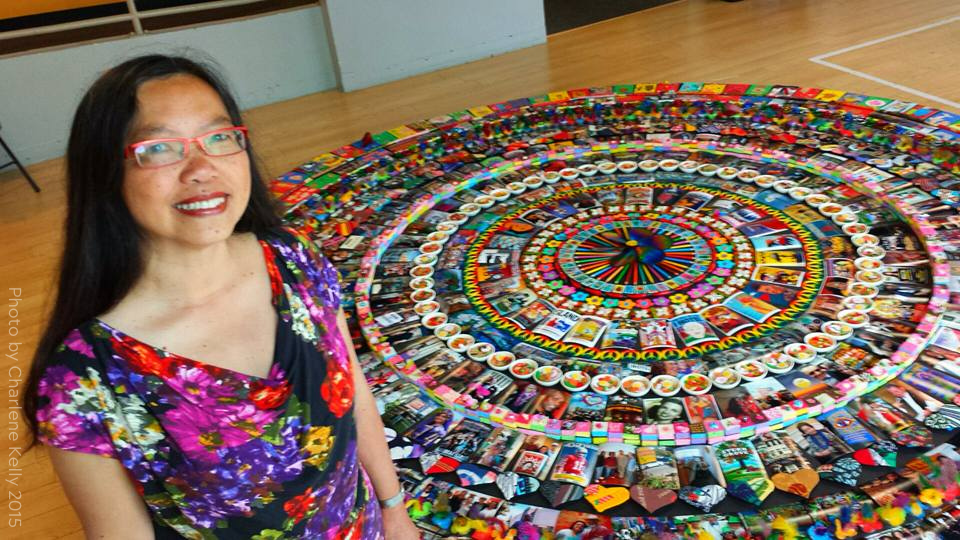
In 2010, I executed my first of several installations. This move toward the 3-D format expanded my artistic options to serve the community. In 2012, I started creating large-scale concentric mandalas, which have become my main art form for the past 13 years. I use the medium of the mandala to show the interconnectedness of life and as a means to promote unity. Made of lots of small purchased or created pieces, each row connects with the next to make a whole piece. We see that no matter where we are, we are part of something bigger than ourselves. Everything feeds into the center; everything radiates from the center.
The mandala can tell a story, celebrate a community, and educate the public on various issues. Its impermanent nature lends itself to reflections on adaptation and change. By offering a bird’s eye view on a situation, it helps us to step back and see the bigger picture. It is an endlessly versatile vehicle as the pieces can be mixed and matched to become something new. The engagement of community members in creating the items is unique to my practice. By blurring the line between artist and audience, we all share ownership of the work. The mandala is also a deep spiritual practice for me. It teaches me about emptiness, impermanence, and interdependence.
After five decades of creating artwork, the four pillars of my life – art, community, activism, and spirituality – are now inseparable. Hopefully, through my example, I can inspire others to find their own artistic path that is in accord with their values. Currently I’m focused on writing my reflections on my life and preparing my archives. I continue to be an active participant and supporter in the communities I have been part of and I remain passionately engaged with life.